
DaVegas positions itself specifically and deliberately for Indian players. Here’s how its actual terms compare to what’s typical in that market.
- Robust Security Measures
- Generous Bonuses and Promotions
- Cryptocurrency Support
- Secure and Fair Gaming
- Country Restrictions
DaVegas vs. The Market: How the India-Focused Setup Stacks Up
Score: 4.5 / 5.0
Most online casinos targeting India bolt on rupee pricing and a UPI button to an otherwise generic platform. DaVegas goes further: it’s built specifically around roulette as its main draw, not slots, with payment rails, live-dealer titles, and even bonus math tuned for an Indian audience specifically. That specialization is the interesting story here, not the welcome bonus headline. Here’s how each part of the actual offer, not the marketing copy, stacks up against what’s typical in this market.
Welcome Offer: Multi-Tier Instead of Single Match
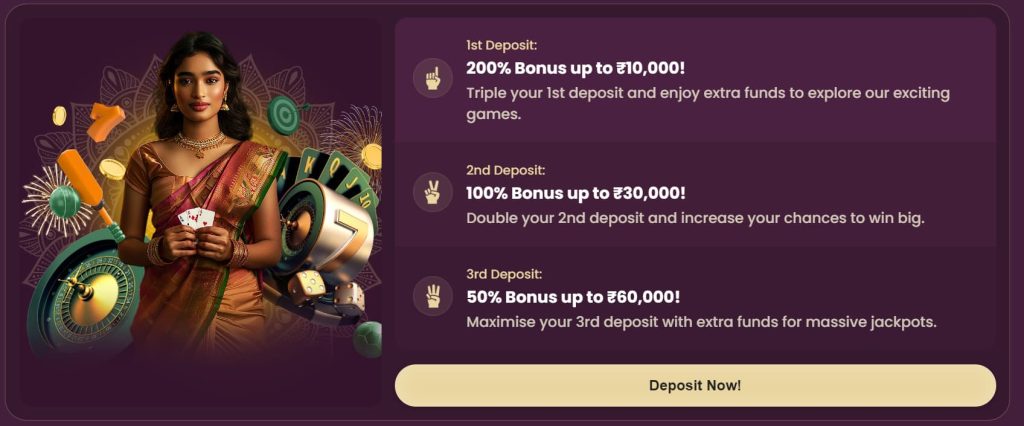
Where most operators front-load everything into one first-deposit match, DaVegas spreads the welcome offer across three separate deposits, changing both the total size and the commitment required to unlock it.
| Typical Operator | DaVegas | |
|---|---|---|
| Bonus structure | Single first-deposit match | Three-tier, across first three deposits |
| Total cap | Often ₹20,000-₹50,000 | ₹100,000 |
| Min deposit | Varies, often ₹500-₹1,000 | ₹500 |
| Promo code required | Sometimes | No, selected at the cashier |
Splitting the welcome offer across three separate deposits rather than front-loading it all on deposit one is a somewhat less common structure. It rewards continued depositing rather than a single lump sum, and the ₹100,000 total cap is on the higher end for the Indian market, using the page’s own tier math rather than the conflicting ₹90,000 figure that also appears on the page.
Most operators requiring a promo code to unlock a bonus add a small extra friction step that DaVegas skips entirely, the bonus is simply selected from the cashier page at deposit time, no code to remember or mistype.
Wagering Disclosure: A Real Gap
A bonus is only as good as the fine print behind it, and this is the one place DaVegas discloses noticeably less than a typical competitor.
| Typical Operator | DaVegas | |
|---|---|---|
| Wagering multiplier stated | Standard practice | Not disclosed |
| Wagering deadline stated | Sometimes | Yes, 30 days |
Most operators disclose both a multiplier and a deadline. DaVegas states only the deadline. That’s a meaningful gap compared to market norms, since the multiplier is the number that determines whether the bonus is realistic to clear, not the deadline. A 30-day window is a reasonable amount of time by market standards. But without knowing whether the target is 20x or 60x the bonus amount, a player can’t judge how achievable that window really is. The difference between those two multipliers on a ₹100,000 bonus is enormous in terms of the betting volume required over the course of that month.

Catalog and Payments: Roulette-First, India-Ready
This is where DaVegas earns its positioning, both the game selection and the payment options are built around one specific audience rather than copy-pasted from a generic template.
| Typical Casino | DaVegas | |
|---|---|---|
| Table roulette variants | Often 5-10 | 20+ |
| Live roulette titles | Often under 10 | 17 |
| Total catalog | Varies widely | 2,000+ |
| India-specific live titles | Rare | Namaste Roulette, Hindi Lightning Roulette |
| India-specific payment rails | Sometimes limited | UPI, PayTM, Netbanking, IMPS |
| Total payment methods | Often 5-7 | 10 |
Most general-purpose online casinos carry a handful of roulette variants alongside a much larger slots library. DaVegas’s 20 or more table variants and 17 separate live titles are unusually deep for a single game type, reflecting the operator’s roulette-first positioning rather than a slots-first one, a real specialization rather than a marketing label.
Having live titles built with an Indian audience specifically in mind (Namaste Roulette, Hindi Lightning Roulette) also goes further than most operators. Most competitors offer the same generic live catalog regardless of target market, with no localized content built for a specific regional audience. That same India-first approach carries through to payments too: ten methods, four of them aimed specifically at Indian banking preferences (UPI, PayTM, Netbanking, IMPS). That’s broader coverage than many operators offer in this market, where UPI and PayTM support in particular can be inconsistent from one operator to the next.
Disclosure Gaps: Licensing and Game Providers
Two separate claims on the page, the license and the studios behind the games, share the same weakness: plausible, but not independently checkable from what’s disclosed.
| Typical Operator | DaVegas | |
|---|---|---|
| License jurisdiction stated | Standard | Curaçao |
| Specific license number | Standard practice | Not disclosed on the reviewed page |
| Providers clearly attributed | Standard practice | Partial |
| Named providers referenced | Varies | Evolution (confirmed), 7 others (footer only) |
Stating a jurisdiction without a specific license number falls short of what more transparent operators disclose. A license number is what lets a player independently check a regulator’s public registry rather than relying on the operator’s own claim, and its absence here means DaVegas’s Curaçao licensing claim, while plausible, can’t be verified the same way a numbered license could be. The same pattern shows up with game providers. DaVegas confirms Evolution specifically and directly for live dealer streaming and its VIP Roulette table, but a broader list (Microgaming, Playtech, Pragmatic Play, Play’n GO, Lucky Streak, Betgames, Ezugi) appears only in the reviewing site’s general footer. None of those seven are tied to DaVegas directly in the body content itself. Both gaps point in the exact same direction: claims that are plausible but harder to independently verify than they should be, the kind of thing a more transparent operator would spell out directly rather than leaving to inference or a footer.
Security, Mobile, and Player Protection
Everything covering how the platform gets used day to day, logging in, reaching support, playing on a phone, staying in control of spend, comes out closer to market-standard than the earlier sections.
| Typical Operator | DaVegas | |
|---|---|---|
| Encryption | Standard SSL | SSL encryption |
| Two-factor authentication | Sometimes optional or absent | Yes, on login |
| Live chat hours | Often 24/7 or business hours | 8 AM-9 PM UTC daily |
| Native app | Sometimes available | No, browser-based only |
| Self-exclusion | Standard | Yes, by request through support |
| Region-appropriate badges | Standard | UK-specific badges (BeGambleAware, GamStop) on an India-targeted page |
Two-factor login authentication isn’t universal in this market, some operators only offer it as an opt-in or skip it entirely, so having it as a standard security measure is a point in DaVegas’s favor. Live chat coverage of roughly 13 hours a day, rather than full 24/7, is more limited than some competitors, though the 24/7 email backup and dedicated FAQ section on the homepage partially offset that gap for players who need help outside those chat hours.
The mobile experience runs through the browser rather than a dedicated app, common in this market and not a disadvantage on its own, plenty of operators run this way successfully, with the roulette-focused layout stated to adapt to smaller screens without losing functionality. Responsible-gambling tools (self-exclusion by request through support, links to Gamblers Anonymous, GamCare, and Gambling Therapy) are in line with market standards. One inconsistency is worth naming, though: the reviewing site displays UK-specific responsible-gambling badges on a page that otherwise targets Indian players exclusively. That’s most likely a templated footer element rather than something DaVegas itself controls, but it’s a mismatch worth noting nonetheless, the kind of detail that can undermine trust in an otherwise solid page.
How It Compares, Overall
4.5/5. The tiered welcome bonus, roulette catalog depth, and Indian payment method coverage all compare favorably against typical market terms, three real strengths that stack up well against what’s typical in this specific market. The score reflects the wagering disclosure gap covered above: stating a 30-day deadline without the multiplier that determines actual difficulty falls short of what more transparent operators in this market disclose. The licensing and game-provider transparency gaps are secondary factors worth weighing alongside it, neither individually disqualifying but adding up to a page that could stand to be more precise across several of its specific claims.